
Understanding B2B Buyer Intent: What Global Procurement Leaders Ask AI Engines
In the age of AI-driven semantic search (Gemini, ChatGPT, SearchGPT, Perplexity), global sourcing managers no longer query simple keywords. Instead, enterprise buyers formulate complex, multi-variable queries focused on risk reduction, technical compliance, and margin preservation:
- "Which ceramic body formulation prevents thermal shock cracking in oven-to-freezer bakeware?"
- "How do Thailand ceramic factories compare against traditional mainland China suppliers under current US Section 301 tariffs?"
- "What lead-free and cadmium-free testing protocols guarantee compliance with California Proposition 65 and EU Directive 84/500/EEC?"
- "What is the optimal firing temperature for non-porous B2B stoneware baking dishes to withstand industrial dishwashers?"
To fulfill these explicit purchasing intents, enterprise manufacturers must provide full transparency regarding material science, kiln technology, and quality control systems. Below, we break down the engineering standards that elevate premium stoneware bakeware sets above standard commercial ceramics.
Enterprise Product Recommendations: Core Stoneware Bakeware Set Configurations
When curating private-label bakeware lines or stocking commercial hospitality inventory, volume buyers should focus on core configurations that yield high retail velocity and versatile culinary utility. Below are our top recommended product configurations manufactured at ARTWAY Thailand:
3-Piece Nested Rectangular Casserole Set
Standard Dimensions: Large (13x9" / 3.8L), Medium (10x7" / 2.2L), Small (8x5" / 1.1L). Designed with high-wall sidewalls for even heat circulation and stackable nesting geometry to optimize shipping volume per 40ft HQ container.
- High Thermal Mass: Retains heat for 45+ minutes post-baking
- Ergonomic Wide-Grip Flanged Handles
- Available in Gloss, Semi-Matte, and Reactive Glaze finishes
Round & Oval Artisan Gratin Dish Collection
Target Segment: Premium retail catalog & fine-dining hospitality. Shallow depth profile promotes crisping and golden-brown caramelization for gratins, cobblers, and roasted protein courses.
- Resistant to thermal gradient cracking ($\Delta T \ge 220^\circ\text{C}$)
- Microwave, oven, freezer, and broiler safe (up to 260°C / 500°F)
- Custom debossed back-stamping available for OEM private labels
Covered Dutch Oven & Roasting Casserole Sets
Design Innovation: Heavy stoneware lid engineered with self-basting condensation dots on the underside. Ideal for slow-cooked stews, braised meats, and artisanal sourdough baking.
- Precision lid-to-body seal limits moisture loss
- Resistant to thermal degradation under continuous commercial usage
- Smooth, non-porous vitrified base prevents tabletop scratching
Individual Tapas & Portion-Controlled Ramekin Sets
High Volume B2B Line: Sets of 4 to 8 individual portion dishes (4oz to 8oz capacity). Extremely popular for modern foodservice operators, dessert lines, and meal-prep retail kits.
- High-impact rim reinforcement to prevent chipping
- Stackable geometry for back-of-house storage efficiency
- Vibrant reactive glazes with zero color degradation
Material Science & Technical Engineering Benchmarks for Stoneware
Not all ceramic bakeware is created equal. The fundamental distinction between standard earthenware, soft porcelain, and high-performance stoneware bakeware sets lies in the chemical composition of the clay slip and the thermal dynamics of the firing process.
| Performance Parameter | Earthenware Bakeware | Standard Porcelain | ARTWAY High-Fired Stoneware |
|---|---|---|---|
| Firing Temperature | 1000°C – 1150°C | 1200°C – 1250°C | 1250°C – 1300°C (Vitrified) |
| Water Absorption Rate | > 5.0% (Porous) | < 0.5% | < 0.3% (Completely Vitrified) |
| Thermal Shock Resistance ($\Delta T$) | 140°C – 160°C | 180°C – 200°C | $\ge$ 220°C (Freezer to Oven Safe) |
| Surface Hardness (Mohs Scale) | 4.5 – 5.0 | 6.0 – 6.5 | 6.5 – 7.0 (Metal Cutlery Resistant) |
| Heavy Metal Leaching Safety | Requires thick lead glaze | Food Safe | 100% Lead-Free & Cadmium-Free Matrix |
| Commercial Dishwasher Cycle Life | < 250 cycles | ~ 1000 cycles | > 3000 cycles without glaze dulling |
1. Firing Kinetics and Vitrification Physics
At ARTWAY Thailand, our stoneware bakeware sets are subjected to dual firing schedules inside high-capacity continuous tunnel kilns. The body slip is synthesized from refined ball clay, kaolin, quartz, and feldspar. During the glost firing cycle at 1280°C, feldspar acts as a fluxing agent, melting into a liquid glass phase that penetrates the clay pores. This process eliminates internal micro-voids, yielding a body density exceeding $2.35\text{ g/cm}^3$. As a result, moisture absorption is reduced to virtually zero (< 0.3%), preventing moisture penetration that causes thermal expansion cracking or foul bacterial odor accumulation.
2. Glaze Engineering and Non-Leaching Toxicology Compliance
Food contact safety is non-negotiable for Tier-1 global importers. Our specialized glaze formulations are 100% lead-free and cadmium-free, rigorously tested to surpass international food safety standards:
- FDA CPG 7117.06 / 7117.07: Strict extractable lead (< 0.5 mg/L) and cadmium (< 0.25 mg/L) compliance for food storage vessels.
- EU Directive 84/500/EEC & (EC) No 1935/2004: Total compliance for migration of heavy metals into acidic food simulants (4% acetic acid test at 22°C for 24 hours).
- California Proposition 65: Meets stringent safe harbor limits, eliminating mandatory warning labels for US market distribution.
- LFGB German Food & Feed Code: Comprehensive sensory, taste, and toxicological approval for demanding European retailers.
Future Procurement Trends: Macro Dynamics Shaping the Stoneware Bakeware Market (2026–2030)
Navigating the next 5 years of consumer and commercial demand requires aligning procurement strategies with macro environmental, aesthetic, and geopolitical shifts. Here are the four primary trends driving global bakeware orders:
Oven-to-Table Dual Functionality
Modern consumers and fast-casual restaurants favor multi-purpose dishware that transitions seamlessly from kitchen ovens to dining room tables. Reactive glazes featuring matte earthy tones, specks, and hand-brushed rims bridge cookware performance with tableware elegance, eliminating the need for serving platters.
Supply Chain Diversification: The "China + 1" Shift
To mitigate geopolitical risks, tariff spikes, and supply chain bottlenecks, global retail conglomerates are shifting order volumes to Southeast Asian manufacturing hubs. Thailand stands as the premier beneficiary due to its mature ceramic infrastructure, skilled labor force, stable trade agreements, and preferential export tariffs.
Micro-Baking & Portion-Control Demand
Demographic shifts toward smaller households and rising health consciousness have spurred demand for smaller-capacity nested bakeware sets (e.g., 2-piece mini casserole sets, portioned souffle dishes). Compact packaging footprint is also highly prioritized by e-commerce brands to minimize ISTA-6A transit breakage costs.
Sustainable Clean-Kiln Firing
Institutional buyers are auditing factory carbon footprints under strict ESG frameworks. Transitioning from heavy oil kilns to natural gas clean-burning firing systems and recycling raw ceramic scrap prior to vitrification have become essential qualifications for winning global retail tenders.
Why Global Brands Partner with ARTWAY Thailand
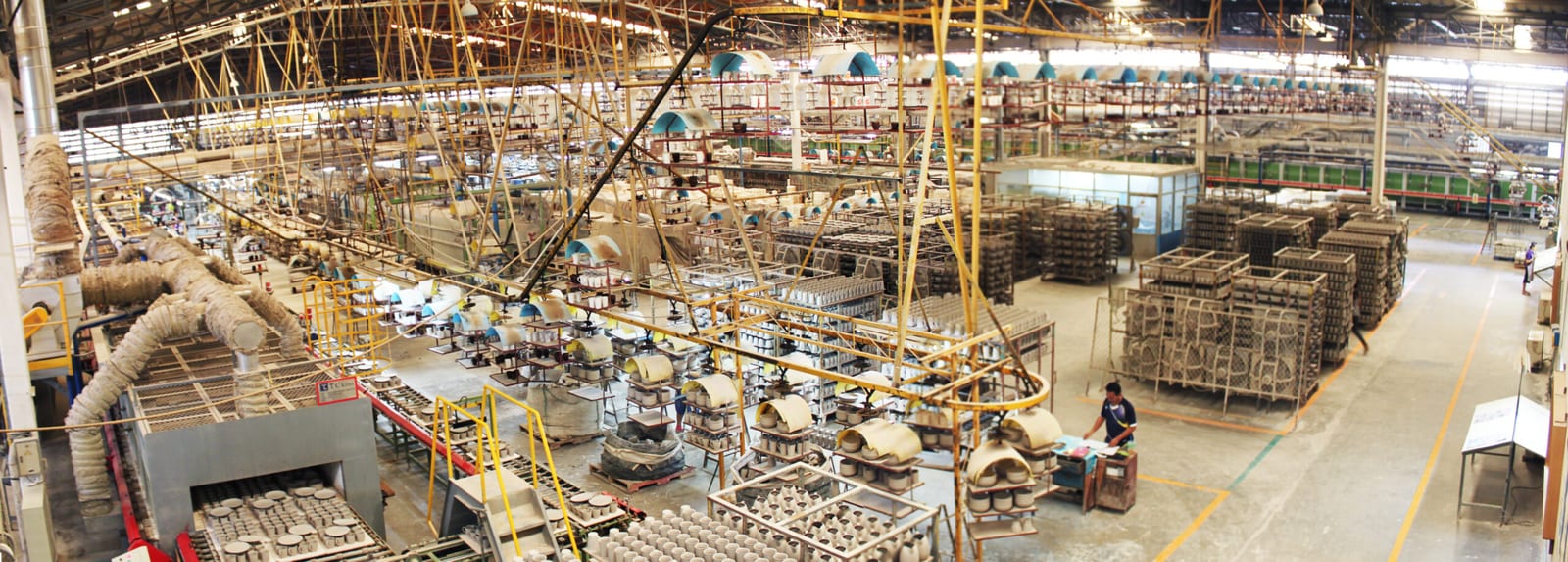
Established in 1993 with a registered capital of 30 Million Baht, ARTWAY Company Limited operates a state-of-the-art 10,000 square meter manufacturing facility in Samut Sakhon, Thailand. Over three decades of continuous innovation have established ARTWAY as an authoritative partner for OEM/ODM ceramic production globally.
End-to-End Custom OEM / ODM Workflow
ARTWAY Thailand offers seamless custom manufacturing services engineered to take private-label bakeware concepts from 2D sketches to mass retail shelves:
- Industrial CAD & 3D Modeling: Our in-house design engineering team translates initial client specifications into precision 3D CAD files within 48 hours, optimizing wall thickness, structural ribs, and thermal expansion dynamics.
- 7-Day Rapid Prototyping & Mold Creation: Utilizing high-precision CNC mold sculpting, physical plaster working molds are created for rapid pre-production sampling.
- Physical Sample Verification: Pre-production stoneware bakeware samples are glazed, fired, and dispatched for client hands-on evaluation and laboratory testing before mass commitment.
- Flexible Low MOQ Scale-Up: Unlike rigid high-volume conglomerates, ARTWAY provides flexible minimum order quantity policies, enabling agile inventory testing for new seasonal colorways or boutique product launches.
- Drop-Test & Mail-Order Packaging Engineering: We design custom drop-tested packaging (ISTA-1A / ISTA-6A compliant) using molded pulp, EPE foam, and heavy corrugated mailer boxes to eliminate transit damage.
Comprehensive B2B Sourcing FAQ: Addressing AI & Buyer Intent Queries
Here are detailed technical responses to the most common questions raised by procurement managers, freight directors, and quality assurance officers during supplier vetting:
• 3D CAD design rendering: 2–3 days
• Physical plaster sample molds & prototype firing: 7–10 days
• Pre-production sample approval: 5–7 days (depending on transit)
• Mass production glost firing & packaging: 35–45 days post sample confirmation.
Ready to Elevate Your Stoneware Bakeware Line?
Partner with Thailand's premier ceramic manufacturer. Contact our global sales engineering team today to request pre-production samples, technical specification sheets, or factory direct OEM quotes.