About
About Us Production CapabilityProducts
All Products Tableware Bakeware Decorative Bathroom Accessories Other Products OEM Services Catalogue News & ActivitiesResources
Ceramic Tableware Manufacturing Stoneware Bakeware Sets Custom Ceramic OEM Manufacturer Decorative Ceramic Home Decor Ceramic Kitchen Storage Jars Stoneware Dinnerware Sets Ceramic Bathroom Accessories Set Ceramic Baking Dish Global Service Top SearchExplore our precision-crafted ceramic dinner sets, commercial HORECA tableware, and bespoke stoneware lines designed for maximum thermal stability, mechanical strength, and aesthetic refinement.
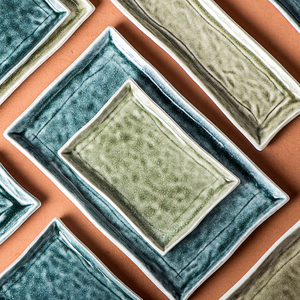

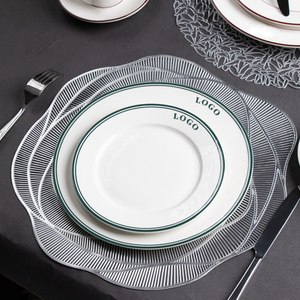
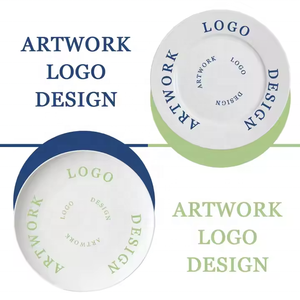
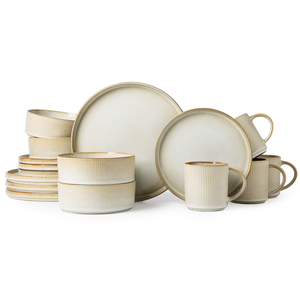
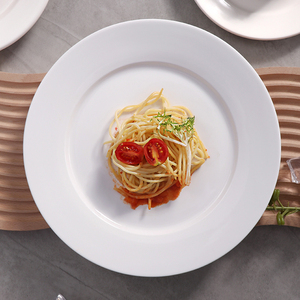

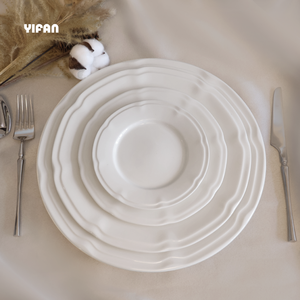
Selecting the ideal ceramic body for commercial hospitality, private label retail, or high-volume enterprise distribution requires a rigorous analysis of mineral composition, firing curves, water absorption rates, and mechanical shear resistance.
In modern industrial ceramic manufacturing, the selection of raw materials directly dictates the end product's structural durability and thermal shock threshold. Clay bodies are composed of precisely balanced ratios of kaolin, feldspar, ball clay, and quartz. When subjected to high-temperature tunnel kilns, these minerals undergo irreversible physical and chemical phase transitions—converting into mullite needles suspended in a crystalline glass matrix.
| Material Property | High-Fired Stoneware | Fine Hard Porcelain | New Bone China |
|---|---|---|---|
| Firing Temperature Range | 1250°C – 1280°C | 1320°C – 1380°C | 1200°C – 1250°C |
| Water Absorption Rate | < 0.5% (Impermeable) | < 0.1% (Non-porous) | < 0.3% (Vitrified) |
| Modulus of Rupture (MOR) | 55 – 70 MPa | 70 – 90 MPa | 65 – 80 MPa |
| Thermal Shock Resistance (ΔT) | Up to 180°C differential | Up to 200°C differential | Up to 160°C differential |
| Commercial Suitability | Artisanal Retail, HORECA, Bakeware | Banquet Halls, Fine Dining, Airlines | Luxury Weddings, High-End Retail |
Glaze chemistry plays a crucial role in preventing cutlery scratching, glaze crazing, and chemical leaching. Our proprietary glaze formulations utilize lead-free and cadmium-free frits that fuse seamlessly into the ceramic substrate during single or double-firing cycles. By adjusting the Coefficient of Thermal Expansion (CTE) between the ceramic body and the glaze layer, we eliminate microscopic tension mismatches—ensuring that every dinner plate withstands rapid cooling and heating cycles without surface failure.
From initial 3D conceptual drafting to mass production and laboratory compliance certification, our streamlined engineering workflow guarantees precision execution for private label brands.
Industrial design engineering utilizing Parametric 3D Modeling to define precise dimensional tolerances, stackability radii, and volumetric capacities prior to mold sinking.
Precision master mold creation utilizing high-density plaster compounds or automated pressure-casting systems for high-consistency rim geometry and uniform body density.
Atmosphere-controlled continuous tunnel kiln firing. Microprocessor temperature curves ensure complete organic burnout and optimum glaze vitrification.
In-glaze or on-glaze custom logo application, reactive glaze sprays, metallic rim detailing, and pad-printing options cured via secondary firing at 800°C–850°C.
100% manual surface audit combined with automated pinhole scanning, rim impact testing, thermal shock validation, and drop-test packaging verification.
Export packaging conforming to ISTA 3A standards. Full compliance documentation for FDA, California Proposition 65, LFGB, and EU Directive 84/500/EEC.
As global consumer preferences shift toward sustainable luxury and commercial operators prioritize operational efficiency, ceramic dinnerware procurement is evolving rapidly.
Flat, uniform white plates are increasingly giving way to artisanal, hand-thrown aesthetics across fine dining and retail sectors alike. Reactive glazes—which interact dynamically with firing temperatures to yield unique color variations, speckles, and metallic halos—allow mass-produced ceramics to convey a bespoke, handcrafted allure while maintaining structural uniformity.
North American and European buyers are enforcing strict ESG benchmarks on overseas ceramic suppliers. Sourcing decisions are increasingly conditioned on low-carbon footprint kilns, heat-recovery systems, closed-loop wastewater filtration, and recycled clay body integration. OEM suppliers that demonstrate waste slurry recycling and plastic-free packaging are capturing a dominant market share.
In high-velocity catering, buffet, and hotel environments, storage efficiency and labor speeds are parametric constraints. Modern dinnerware sets are engineered with reinforced foot rims, precise stacking shoulders, and light-weighting geometries that reduce stack tipping risks while lowering shipping weights by up to 12% without sacrificing edge impact resistance.
Established in 1993, ARTWAY Company Limited brings over three decades of ceramic engineering mastery, supplying premium stoneware, bakeware, and tableware to tier-one global brands.
Located in Samut Sakhon, Thailand, our integrated manufacturing complex operates high-capacity tunnel kilns, automated pressure moulding units, and dedicated quality-control labs.
Our workforce combines decades of traditional ceramic craftsmanship with modern materials science, guaranteeing zero-defect production runs across complex OEM briefs.
We accommodate both boutique brand custom collections and multi-container commercial contract orders, providing sample rapid-prototyping in under 14 working days.
Exporting to over 40 countries across Europe, North America, and Asia. Leveraging Thailand's strategic export trade agreements for preferential tariff treatments.
Essential technical and commercial insights for procurement managers, hospitality buyers, and private label importers.