About
About Us Production CapabilityProducts
All Products Tableware Bakeware Decorative Bathroom Accessories Other Products OEM Services Catalogue News & ActivitiesResources
Ceramic Tableware Manufacturing Stoneware Bakeware Sets Custom Ceramic OEM Manufacturer Decorative Ceramic Home Decor Ceramic Kitchen Storage Jars Stoneware Dinnerware Sets Ceramic Bathroom Accessories Set Ceramic Baking Dish Global Service Top Search
Explore industry trends, OEM ceramic manufacturing guides, tableware design ideas, and expert tips from ARTWAY Thailand.
Choosing the right ceramic canisters with lids can improve storage, presentation, and daily kitchen habits. In 2026, global buyers face more choices, from hand-finished stoneware to smooth porcelain with bamboo, silicone, or ceramic seals. Each material behaves differently.
This guide examines practical details that product photos often hide. We consider lid fit, glaze quality, wall thickness, capacity, moisture resistance, cleaning needs, and shipping protection. A tight lid should close smoothly without scraping the rim. A dependable canister should also stand steadily on a crowded countertop. For coffee, tea, flour, sugar, spices, and snacks, the correct size matters as much as appearance. Oversized containers may waste space, while narrow openings can make scooping frustrating.
Our recommendations are informed by product specifications, user-focused evaluation, and common quality checks used in kitchenware purchasing. We also consider food-contact information, care instructions, packaging strength, and regional import expectations. Buyers should verify current supplier documents and local requirements before ordering large quantities. Standards and seller policies can change.
Small flaws matter.
Handmade surfaces may show slight color variation. That can add character, but it may also reduce uniformity across a set. Silicone seals can improve freshness, yet they may require more careful cleaning. Ceramic lids look elegant, although they can be heavier and more fragile during delivery. We will not treat every attractive design as a reliable choice. Instead, this overview helps buyers compare real performance, long-term value, and visual appeal with clearer expectations.
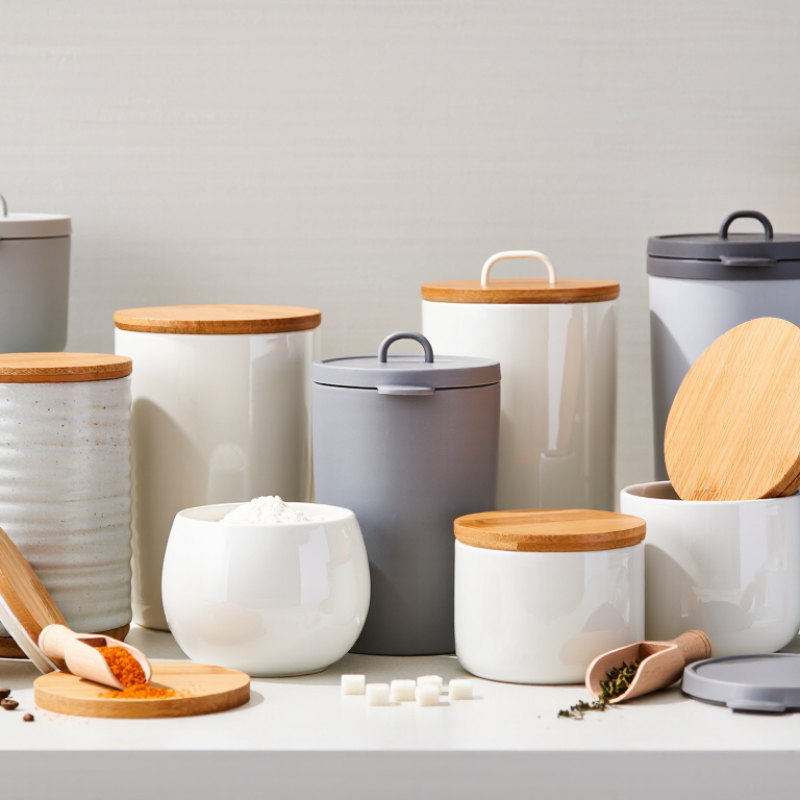
Ceramic canisters with lids are reusable storage containers made from fired clay and finished with a glaze. The glaze creates a smoother surface and helps reduce moisture absorption. A fitted lid may include silicone, cork, wood, or another food-contact material.
Ceramic provides weight and stability on a kitchen shelf. It also resists odors better than many lightweight plastic containers.
Not completely airtight.
The lid design matters more than appearance. A silicone gasket can improve the seal, while a loose wooden lid may suit dry ingredients only. In practical use, flour, tea, rice, coffee, and spices stay organized inside these containers.
However, ceramic can chip when dropped, and tiny cracks deserve careful inspection. Wash the body gently, then dry the inner rim before closing it.
Market estimates show growing interest in ceramic tableware. Grand View Research valued the global ceramic tableware market at about USD 10.8 billion in 2023, with continued growth forecast through 2030.
Fortune Business Insights estimated the market at USD 10.72 billion in 2023 and projected USD 16.03 billion by 2032. The figures differ because each report uses a different market scope.
Buyers should check glaze safety, lid fit, capacity, and care instructions rather than trust decorative photos alone. Personally, I would test the lid with a small amount of flour before storing expensive ingredients.
For global buyers, ceramic canisters should balance material safety, durability, and daily handling. Grand View Research estimated the global ceramic tableware market at about USD 10.4 billion in 2023. It also forecasts steady growth through 2030. This trend reflects demand for reusable kitchen storage with refined finishes.
Porcelain offers low porosity and a smooth, dense body. Stoneware provides greater visual weight and strong everyday resistance. Earthenware costs less, but its porous body needs a dependable glaze and careful moisture control. Food-contact glaze testing matters. Buyers should request lead and cadmium migration reports for the destination market. Glaze thickness also deserves attention. A glossy surface can hide pinholes, crawling, or early crazing.
Construction details often decide long-term performance. Look for a flat foot ring, even wall thickness, and a lid that sits without wobbling. Silicone or food-grade rubber seals can reduce air exchange. They may still lose flexibility after repeated washing. The lid should also include a small clearance gap, preventing pressure problems during temperature changes. Avoid sudden movement from a hot canister to a cold stone counter.
A practical weakness remains.
Decorative glazes can attract buyers while masking uneven firing. I would inspect the rim under strong light. Small defects matter there. Mordor Intelligence projects continued growth in ceramic tableware demand, but market growth does not guarantee consistent quality. Sample testing is wiser than relying on photographs.
2026 Best Ceramic Canisters With Lids For Global Buyers
How to Evaluate Sizes, Seals, and Storage Performance
Choosing ceramic canisters starts with usable volume, not appearance. A 500 ml jar suits tea, while a 1.5 litre canister fits flour or rice. Measure shelf depth carefully. Leave two centimetres above the lid for comfortable handling. Regional kitchens also vary, so metric dimensions should appear beside imperial conversions.
Seal quality controls moisture, odour, and pests. A silicone gasket should sit evenly inside a clean, continuous rim. Test it with a gentle inversion over a sink, not above your food. A loose lid is obvious. Slow air exchange is harder to detect. USDA FoodKeeper guidance supports airtight storage for many dry foods, although recommended storage times differ by product. Ceramic bodies also need a smooth, intact glaze. The FDA Food Code 2022 describes food-contact surfaces as smooth, easily cleanable, and resistant to pitting.
Storage performance deserves practical testing. Fill one canister with flour and check for clumping after several humid days. Record the starting weight, lid condition, and room humidity. UNEP’s Food Waste Index Report 2024 estimates that 1.05 billion tonnes of food were wasted in 2022, including household waste. Better containers cannot solve waste alone, but clear labels and right-sized volumes can reduce forgotten supplies. I would not trust a “sealed” claim without a gasket test. Even then, results may change with altitude, temperature, and repeated washing.
Ceramic canisters with lids serve different needs across global markets. Buyers should match the shape, seal, and glaze to local habits. In humid tropical regions, wide-mouth canisters with tight silicone seals help protect tea, coffee, and dry grains. However, seals can weaken under heat. I have found that removable gaskets are easier to clean and replace.
Northern European kitchens often favor tall, stackable canisters with calm colors and clear capacity markings. They save counter space during long winters and suit organized pantry storage. Mediterranean households may prefer broad ceramic jars for pasta, flour, or olives. These jars need stable bases because shelves can become crowded. Middle Eastern buyers often value larger bodies and decorative reliefs, but heavy lids can become inconvenient during daily use.
East Asian markets may favor compact canisters for tea, spices, and small servings of rice. Smooth inner walls reduce residue and make washing simpler. In North American homes, larger modular sets can support bulk storage, although oversized pieces may be difficult to lift. That detail is easy to overlook. For every market, buyers should check lead and cadmium testing, food-contact documentation, glaze durability, and packaging strength. Independent laboratory reports provide stronger evidence than attractive product claims. I would not assume one lid design works everywhere. Local climate, hand size, shelf depth, and cleaning habits still matter. My own selection process has missed these practical details before, so sample testing remains worthwhile.
The index rates how well each canister type matches common dry-food storage needs in each region, using a 1–5 buying-guide scale. Airtight ceramic canisters are best for dry goods such as rice, flour, tea, coffee, sugar, and spices; they should not be used as a substitute for refrigeration or safe storage of perishable foods. Larger capacities generally suit staple foods, while smaller lidded jars are more practical for spices and tea.
When selecting ceramic canisters with lids for global buyers, verify food-contact safety before comparing colors or shapes. Request test reports for lead and cadmium migration, glaze composition, and lid materials. Requirements vary by destination, so a supplier’s general certificate may not satisfy every market. Check the production date, testing laboratory, and product description carefully. Paperwork matters.
A practical inspection should include the rim, inner glaze, lid fit, and silicone or wooden components. Look for pinholes, sharp edges, hairline cracks, and uneven sealing. Fill one canister with dry rice, close it overnight, and check for moisture or odor. The result is not a laboratory test, but it reveals careless finishing. I have learned that attractive glaze colors can hide small surface defects. That deserves a second look.
Tips: Confirm dimensions in centimeters and inches. Ask for carton strength, drop-test results, pallet details, and maximum stacking height. Use moisture-resistant inner protection for long sea shipments. Clarify Incoterms, insurance responsibility, customs documents, and the correct product classification before payment. Request pre-shipment photos and an independent inspection for large orders. Do not assume “airtight” means moisture-proof. Shipping damage often begins with loose lids, weak dividers, or oversized cartons. Be specific.
| Canister Type | Recommended Use | Typical Capacity | Typical Size Range | Common Ceramic Body | Lid Construction | Sealing Performance | Food-Safety Priorities | Temperature Guidance | Global Buying Checks | Shipping Considerations |
|---|---|---|---|---|---|---|---|---|---|---|
| Small spice canister | Dried spices, herbs, tea leaves, and seasoning blends | 250–500 ml | Approx. 8–12 cm high; 7–10 cm diameter | Glazed stoneware or porcelain | Fitted ceramic, bamboo, wood, or food-contact polymer lid | Basic dust protection; usually not airtight unless fitted with a silicone gasket | Lead- and cadmium-migration testing; smooth, intact interior glaze; no exposed decorative pigments on food-contact surfaces | Suitable for ambient storage; avoid direct flame, stovetop, and sudden thermal shock | Confirm net capacity, interior glaze coverage, odor neutrality, and lid fit after repeated opening | Use individual cushioning, dividers, and a moisture-resistant inner carton; small parts should be secured against movement |
| Medium pantry canister | Sugar, salt, rice, pasta, coffee, grains, and baking ingredients | 750 ml–1.5 L | Approx. 15–22 cm high; 10–14 cm diameter | High-fired stoneware or porcelain | Flat ceramic lid, wooden lid, or polymer lid with silicone seal | Good dry-storage protection; gasketed designs provide better moisture resistance | Verify food-contact compliance for the glaze, pigments, gasket, adhesive, and any metal components | Room-temperature storage is recommended; do not move a hot canister onto a cold surface | Request production tolerances, glaze-finish samples, lid interchangeability, and carton drop-test results | Use molded pulp or EPE inserts, corner protection, and a double-wall export carton; test packed drop resistance |
| Large bulk-storage canister | Flour, cereal, pet treats, dry beans, and bulk pantry goods | 2–4 L | Approx. 22–32 cm high; 14–20 cm diameter | Thick-walled stoneware | Heavy ceramic lid or gasketed polymer/wood lid | Moderate to high moisture resistance when the gasket is correctly compressed | Check wall thickness, glaze uniformity, rim flatness, gasket material, and maximum fill weight | Not intended for oven, microwave, freezer, or dishwasher use unless expressly tested and labeled for that use | Confirm empty weight, usable internal volume, carton dimensions, pallet pattern, and handling marks | Higher breakage risk and freight cost; use separated compartments, compression-resistant cartons, and pallet banding where appropriate |
| Airtight-style canister | Moisture-sensitive foods such as coffee, tea, flour, and powdered ingredients | 500 ml–2 L | Approx. 12–28 cm high; 9–16 cm diameter | Glazed stoneware or porcelain with a precisely finished rim | Silicone-gasket lid, clamp lid, or fitted polymer insert | Best available option for routine dry-food storage, but not a substitute for vacuum packaging | Test gasket food-contact suitability, odor transfer, compression recovery, and seal performance after cycling | Ambient storage only unless the complete product has documented thermal testing | Ask for leakage or seal-test criteria, closure-cycle results, replacement-gasket availability, and assembly instructions | Protect the lid, gasket, and rim separately; prevent side loading and compression that can deform the seal |
| Stackable modular set | Coordinated pantry organization and retail multipacks | Three to five pieces; 400 ml–2 L each | Individual height commonly 10–28 cm | Uniformly fired stoneware or porcelain | Low-profile fitted lids, often with silicone or polymer sealing rings | Varies by lid design; stacking stability is separate from airtight performance | Check glaze consistency between sizes, base stability, lid alignment, and food-contact components across the entire set | Do not stack when hot; avoid uneven or over-height stacking during use | Confirm nesting or stacking tolerances, set completeness, barcode/label placement, and replacement-unit policy | Pack each piece individually and add anti-slip separators; validate the fully assembled set for vibration and impact |
| Decorative display canister | Countertop storage where appearance is a major purchasing factor | 800 ml–2 L | Approx. 16–28 cm high; 10–17 cm diameter | Glazed ceramic, stoneware, or porcelain | Decorative ceramic, wood, or polymer lid | Usually basic closure unless a gasket is specified | Confirm that metallic lusters, painted details, and printed decorations are not used on food-contact areas | Keep away from direct heat and rapid temperature changes; decorative finishes may have additional care limits | Review color tolerance, pattern registration, scratch resistance, odor, and visual inspection standards | Use abrasion protection for glossy or patterned surfaces; separate lids from bodies to prevent scuffing |
| Porcelain premium canister | Tea, coffee, confectionery, and gift-oriented dry storage | 500 ml–1.5 L | Approx. 12–24 cm high; 9–14 cm diameter | Vitreous porcelain with a low-porosity body | Precision-fitted ceramic, wood, or polymer lid | Good odor resistance; airtight performance depends on the closure and gasket | Require migration compliance for glaze and decoration, plus clear care instructions for mixed materials | Ambient storage; thermal use must be supported by documented product testing | Check whiteness or color consistency, dimensional tolerance, rim quality, and premium-packaging requirements | Use high-density protective inserts and presentation cartons inside a certified export shipping carton |
| Commercial kitchen canister | Frequent-use storage in cafés, bakeries, restaurants, and catering operations | 1–4 L | Approx. 18–32 cm high; 12–20 cm diameter | Durable glazed stoneware or porcelain | Gasketed lid designed for repeated handling | Moderate to high, provided the gasket and rim remain undamaged | Prioritize cleanability, chip resistance, chemical compatibility, and documented food-contact testing | Commercial dishwasher or thermal use should not be assumed without written manufacturer instructions | Request cycle testing, spare-part availability, lot traceability, defect limits, and cleaning guidance | Use stronger inserts and lower carton stacking heights; include a breakage allowance only when commercially agreed |
| International compliance note: Ceramic food-storage products should be evaluated against the destination market’s applicable food-contact rules. Common reference frameworks include EU Regulation (EC) No. 1935/2004 and related ceramic food-contact requirements, U.S. FDA food-contact requirements and lead/cadmium controls, and China’s GB 4806.4 requirements for ceramic food-contact products. Buyers should obtain current third-party test reports, declarations of compliance, material specifications, and care instructions for the finished product and every food-contact component. Shipping classifications, packaging tests, labeling, and import documentation must be confirmed for the destination country before order placement. | ||||||||||
Porcelain has a dense, low-porosity body and smooth interior. Stoneware feels heavier and handles daily use well. Earthenware costs less, but it needs reliable glazing and careful moisture control.
Request lead and cadmium migration reports for the destination market. Ask for glaze composition and lid-material details. Check the laboratory, production date, and exact product description.
Examine the rim under strong light. Look for pinholes, sharp edges, hairline cracks, and uneven glaze. A beautiful surface can still hide poor firing.
The lid should sit evenly without wobbling. Silicone or food-grade rubber seals can reduce air exchange. Removable gaskets are easier to clean and replace.
No. “Airtight” does not automatically mean moisture-proof. Fill one canister with dry rice overnight and check for moisture or odor. It is useful, but not laboratory proof.
Wide-mouth canisters with tight seals suit humid regions. They work well for tea, coffee, and dry grains. Seals may weaken in heat, so inspect them regularly.
Tall, stackable canisters save shelf space. Broad jars suit pasta, flour, or similar staples. Compact containers fit tea, spices, and small rice portions. One lid style will not suit everyone.
Confirm carton strength, drop-test results, pallet details, and stacking limits. Use moisture-resistant inner protection for long sea shipments. Loose lids and weak dividers can cause damage.
Market growth does not guarantee consistent quality. Test the lid fit, inner glaze, seal, and dimensions before a large order. I have overlooked hand size and shelf depth before. That mistake was avoidable.
Ceramic canisters with lids are practical storage containers designed to protect food, spices, tea, coffee, and household ingredients from light, moisture, odors, and everyday contamination. This article explains how clay bodies, food-safe glazes, wall thickness, and carefully fitted lids influence durability, appearance, and performance. It also examines different closure systems, including silicone or other sealing elements, while showing buyers how to compare capacity, opening size, stackability, ease of cleaning, and long-term storage reliability.
For international buyers, the best canister type depends on local climate, household habits, retail preferences, and intended use. The guide outlines suitable options for compact kitchens, humid environments, gift markets, and larger hospitality applications. It also highlights practical purchasing considerations such as food-contact safety documentation, consistent dimensions, protective packaging, labeling, breakage prevention, shipping conditions, and import requirements. Together, these points help buyers select attractive, durable, and responsibly manufactured ceramic storage solutions for different global markets.